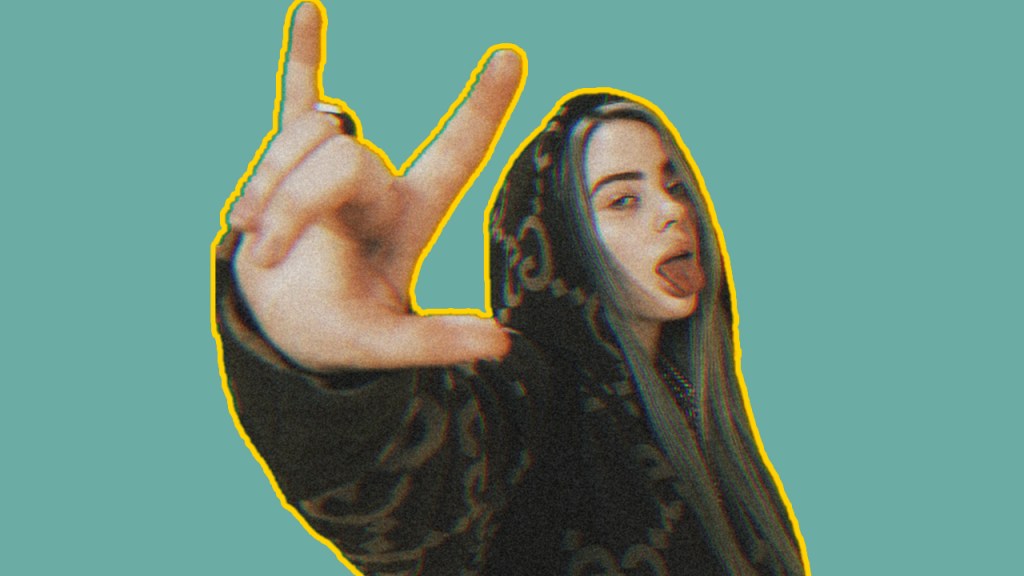
Another stream-of-consciousness post about white people and hip-hop. I’ll try to make this brief.
Billie Eilish’s recent comments about hip-hop were disappointing, but not surprising.
Let me start by saying this: I like Billie Eilish. After initially being relatively unmoved by the release of her debut album When We All Fall Asleep, Where Do We Go?, I revisited it towards the end of last year, and I began to appreciate what she was doing. Her approach to pop music, admittedly, was intriguing, and when you look past the incessant whisper-singing, she actually has real, unique vocal talent.
Based on her music and her fashion aesthetic, anyone can tell that she draws heavily from hip-hop and street culture. That’s obvious and undebatable, and she’s even admitted it to an extent. Given that she’s grown up in an era in which hip-hop is as big/bigger than pop music, I viewed this influence as natural osmosis, instead of conscious appropriation. And while her image could certainly have been manufactured by her label, I wanted to be optimistic and believe that her dabbling was just honest appreciation.
But then she opened her mouth.
In an interview with Vogue, she posited herself as a “storyteller” while describing the difference between storytelling and lying in music, seemingly calling out hip-hop in the process.
“Just because the story isn’t real doesn’t mean it can’t be important. There’s a difference between lying in a song and writing a story. There are tons of songs where people are just lying. There’s a lot of that in rap right now, from people that I know who rap. It’s like, ‘I got my AK-47, and I’m fuckin’ . . .’ and I’m like, what? You don’t have a gun. ‘And all my bitches. . . .’ I’m like, which bitches? That’s posturing, and that’s not what I’m doing.”
My problem isn’t necessarily with the thesis of her argument — “there’s a difference between lying in a song and writing a story” — because there’s certainly an interesting debate that can be had about that. My problem is with the inconsistency with which this argument is applied in the real world, and the audacity of white people who borrow extensively from Black artists but think they suddenly have a pass to critique Black art.
If we’re being technical, rap is not the only genre that relies on “posturing,” as Eilish puts it. Literally every genre does. The difference is that the music world doesn’t seem to view *Black* storytellers and *white* storytellers the same. When Eilish creates a sinister caricature of herself, that isn’t based in reality, on her hit song “Bad Guy,” it gets hailed for its storytelling and creativity. So why is hip-hop — a genre widely known for its adroit storytelling, whimsical narration, bombastic caricatures, and playful exaggeration — constantly derided as being fake and full of liars? Why is hip-hop not afforded the same grace? Seems a bit hypocritical and racist to me.
It also goes without saying that white people are not spokespeople for hip-hop, regardless of how involved they are in hip-hop in 2020. If we learned anything from Miley Cyrus in 2017 and Post Malone in 2018, it’s that, more often than not, people who have the privilege of not being intrinsically tied to Black culture tend to lack a substantive understanding of the culture they repeatedly jump in and out of. Billie Eilish appears to be the latest example, which honestly hurts to say, because I was really hoping she was different.
I will say this, though: as disappointing as Eilish’s comments were, I’m not mad, and I don’t plan on “cancelling” her (unless this gets out of hand). I understand that she’s a brand new, “edgy”, unpolished pop star who’s only 18 years old, and whose team really failed her by not doing their job to educate her on this issue before she ran her mouth in an interview. She will, almost undoubtedly, look back on these comments with regret 4 or 5 years from now — when she’s a veteran pop star with more maturity, knowledge, and perspective.
At least, that’s the hope.





 Black Spasmodic
Leave a comment